Support for Ukrainian artists in Austria
table of contents
15–16 October 2026 – International Conference – Kunsthaus Graz
A look back at the international conference "Networks of Cooperation: Sustainable Structures for Ukrainian Cultural Actors in Europe and Beyond", 15-16 October 2026 at Kunsthaus Graz.
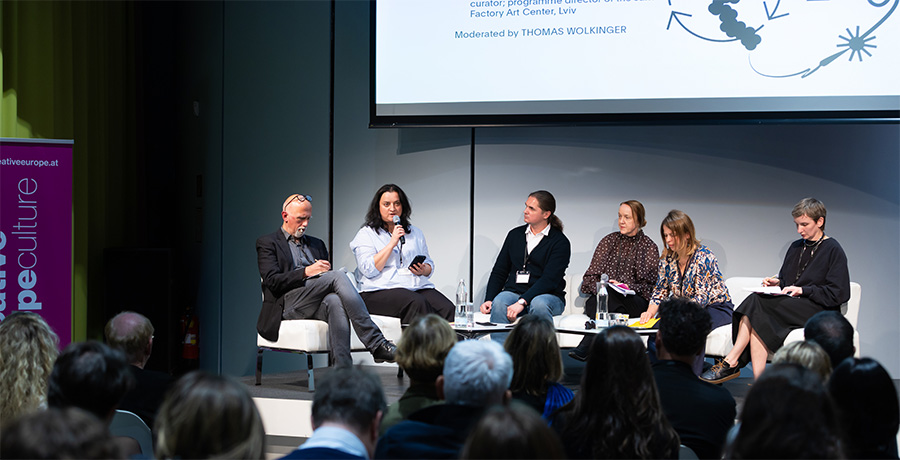
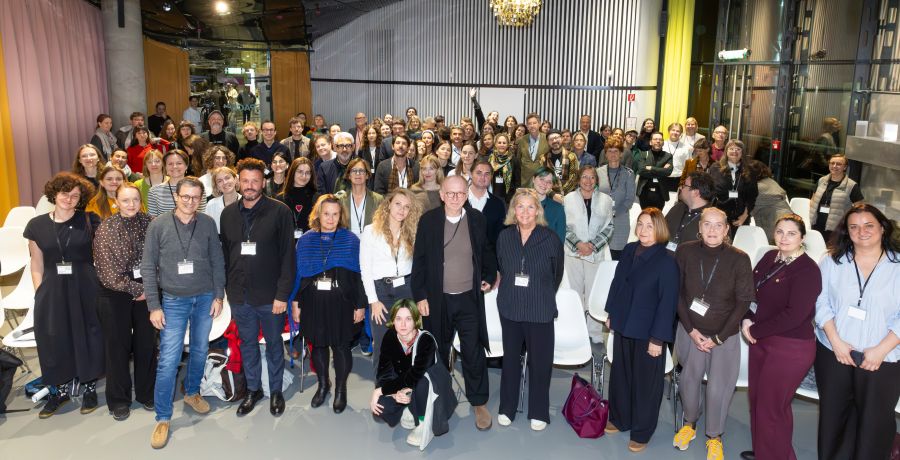
How can the emergency aid provided since the beginning of Russia’s full-scale invasion of Ukraine be transformed into a lasting European-Ukrainian cultural partnership? This was the central question addressed on 15 and 16 October 2026, at the Kunsthaus Graz. More than 130 Ukrainian and European cultural workers, as well as representatives from cultural institutions, networks, funding bodies, politics, research, and civil society participated to the conference. The Graz Declaration, a result of the conference, calls for flexible funding structures, equitable access to European programmes, and continuous networking between Ukrainian and European cultural actors. The significant resonance and unanimous adoption of the Graz Declaration clearly signal a commitment to long-term cooperation and immediate solidarity.
The conference "Networks of Cooperation" was organized by Office Ukraine (Wien/tranzit.at and Graz/rotor), the Austrian Federal Ministry of Housing, Art, Culture, Media and Sport, and the Creative Europe Desk Austria, in cooperation with Kunsthaus Graz, the Creative Europe Desk Ukraine, and the Institute for Human Sciences.
The results of the working groups and roundtables have been integrated into the Graz Declaration. Its starting point: The European solidarity of recent years has enabled vital emergency aid; now, a transition to long-term institutional relationships and sustainable access for Ukrainian cultural workers to European structures is required. Culture is explicitly understood as an important factor for the European integration of Ukraine.
Graz Declaration: Towards a sustainable European-Ukrainian cultural partnership (PDF, 827 KB)
The Declaration serves as a reminder that since 2015, Ukraine has been participating in the EU programme "Creative Europe". Ukrainian cultural actors should therefore be understood as experienced and equal partners within the European cultural landscape. Thus, the existing European support should be continued and strengthened, and more closely aligned with the actual conditions of cultural work both in and outside of Ukraine.
Flexible funding instead of a permanent state of emergency
Central demands include multi-year and adaptable funding models that can also respond to changing security situations. Infrastructure and personnel costs, fair pay, and local cultural production should be taken into account, as well as the possibility of flexible budgets and timelines under extraordinary circumstances. At the same time, the Graz Declaration calls for fairer access to European funding programmes. Furthermore, Ukrainian expertise must be considered during the conception and evaluation of European and national cultural funding programs.
Participants also emphasized the need for continuous networking withing and of existing structures. Cooperations between institutions in Ukraine, Ukrainian initiatives abroad, municipalities, universities, as well as cultural and civil society networks, should not remain solely project-based, but should be based on shared responsibility, resources, and program development. This explicitly also involves strengthening the connections between existing networks within Ukraine.
Exchange must work in both directions
Artistic residencies, mobility programmes, and scholarships also remain important, but should be supplemented by hybrid, local, short-term, and digital forms of cooperation. Not everyone can or wants to leave their place of work and residence. Therefore, mobility must not become a prerequisite for cultural participation.
At the same time, the Declaration emphasizes the reciprocal nature of Capacity Building: it is not only Ukrainian actors who can benefit from European structures. European partners can also benefit from Ukrainian experiences when it comes to cultural resilience, self-organization, civic engagement, and institutional development.
The power of personal encounters
The discussions in Graz highlighted the critical role that personal encounters play in fostering sustainable transnational networks. At the same time, there is a need for safe spaces to openly address tensions and difficult questions. This includes the increasing frictions between artists and cultural professionals who remained or had to stay in Ukraine and those who left the country. Issues of mental health, humane working conditions, the visibility of Ukrainian art, and support for those who continue to work in Ukraine also played an important role in the discussions.
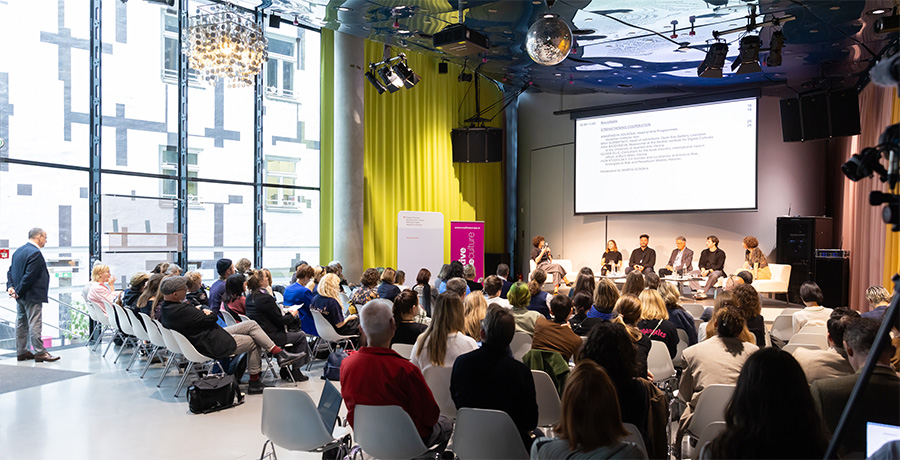
Discussions also covered possibilities to align European programmes more closely with the specific needs of Ukrainian cultural actors—for example, through low-threshold funding models for smaller and rural organisations, easier access to European networks, support for project development and travel costs, targeted matchmaking, and new forms of follow-up and cooperation projects.
Commitments for the years 2027 to 2030
Finally, the Graz Declaration issues a concrete call to European and Ukrainian authorities, governments, cities and regions, cultural institutions, artists, universities, foundations, professional associations, and civil society networks. These commitments should inform concrete programmes and cooperation agreements between 2027 and 2030, with opportunities to review progress together.
The focus is on longer funding periods, fair access for individuals and smaller organisations, sustainable European partnerships, support for cultural work within Ukraine and under conditions of displacement, as well as mutual exchange and Capacity Building.
The conference and the Graz Declaration are thus not intended as a conclusion, but as part of a long-term process. The dialogue between Ukrainian and European cultural actors is to be continued. The shared objective of the conference participants is to build a European cultural space in which Ukrainian artists and institutions are equal partners and co-creators.
A detailed report containing the results of the conference will be published as part of Buch Wien (November 25–29, 2026).
Downloads and press photos:
Graz Declaration (PDF, 827 KB)
Press photos on Picdrop:
Office Ukraine – Support for Ukrainian Artists
"Office Ukraine – Support for Ukrainian Artists" was founded in February 2022 on the initiative of the Austrian Federal Ministry of Housing, Arts, Culture, Media and Sport (formerly BMKOES), together with representatives of civil society and the Austrian arts and culture scene. The initiative supports Ukrainian artists and cultural workers from all disciplines who fled from Ukraine to Austria to escape the Russian invasion through networking, counseling, listening, practical support and donations.
So far, the Offices in Vienna (tranzit.at), Graz (tranzit.at, < rotor > Center for Contemporary Art) and, until 2025, Innsbruck (Künstler:innenhaus Büchsenhausen) have assisted and supported around 2.000 artists from Ukraine.
More information:
- www.artistshelp-ukraine.at
Office Ukraine – Support for Ukrainian Artists
Special Funding Programme “Ukraine-Hilfe” (Support for Ukrainian artists) 2022-2024
In the spring of 2022, the Austrian Ministry of Arts and Culture launched the special funding programme “Ukraine-Hilfe” (Support for Ukrainian artists) for Ukrainian artists in Austria.
This special funding programme provided rapid and targeted support for Ukrainian artists who had been displaced by the Russian invasion of Ukraine and who had found refuge in Austria. The financial resources were made available both in the form of work grants and project grants. The programme aimed to enable them to live and work safely in Austria. The support also was essential in establishing a framework for networking and the exchange of Ukrainian artists within Austria’s arts and culture scene. Eligible applicants included, on the one hand, individuals and cultural institutions in Austria from all artistic disciplines that provided support to artists displaced from Ukraine or that developed joint projects in Austria or in Ukraine, and on the other hand, artists displaced from Ukraine who were residents of Austria.
From 2022 to 2024, 161 work grants and 90 project grants amounting to EUR 1,12 million were awarded by the Austrian Ministry of Arts and Culture.
- Examples of funded projects
Video series "Ukrainian Artists in Austria" and other project examples funded by BMWKMS
Since 2025, the Austrian Ministry of Arts and Culture and Office Ukraine – Support for Ukrainian Artists have been increasingly focusing on introducing Ukrainian artists in Austria to the existing funding systems and on reinforcing their networking with the Austrian arts and culture sector via capacity building projects (e.g. the programme FOCUS INTERNATIONAL Ukraine 2025).
FOCUS INTERNATIONAL Ukraine 2025
FOCUS INTERNATIONAL Ukraine 2025 was modelled after the programme FOCUS INTERNATIONAL of the Austrian Ministry of Arts and Culture: with this programme, the Ministry promotes international artistic and cultural exchange – in both directions: it supports Austrian artists and art projects in the cooperation country, but is also committed to Austria’s internationality when it comes to bringing artists and cultural workers to Austria within the framework of the programme.
Based on this model, FOCUS INTERNATIONAL Ukraine 2025 was a programme of the Austrian Ministry of Arts and Culture, organised and hosted by Office Ukraine/Künstler*innenhaus Büchsenhausen, which provided 6 Ukrainian artists and cultural workers with two-month residencies:
- 3 internships for Ukrainian artists who had moved to Austria because of Russia’s large-scale war of aggression against Ukraine: Traineeship Programme
- 3 residency spots for artists living in Ukraine: (Re)Creation Residency
Traineeship Programme
The goal of the Traineeship Programme was to shape bilateral cultural cooperation between Austria and Ukraine via networking and Capacity Building. It offered Ukrainian artists and cultural workers already living in one of the Federal States in western Austria the opportunity to build up a professional network and cooperations within the Austrian cultural sector. The programme consisted of three two-month long internships hosted by three different cultural institutions in the greater Innsbruck area:
- Literaturhaus am Inn (literature);
- Galerie St. Barbara / musik+ (music);
- Taxispalais – Kunsthalle Tirol (visual arts).
Framework
- 2 months internship in a cultural institution in the greater Innsbruck area;
- studio flat at Künstler*innenhaus Büchsenhausen or GRUNDin Rietz;
- monthly scholarship of EUR 1.300,- (for two months a total of EUR 2.600,-);
- reimbursement for up to EUR 600,– per month to cover the costs for accommodation.
Institutions
TAXISPALAIS Kunsthalle Tirol is a non-profit art center focusing on contemporary art. Temporary exhibitions of international art explore timely questions and stimulate discourse. Alongside the shows, the TAXISPALAIS hosts artist talks, lectures, performances, and panel discussions. Located in one of Innsbruck’s earliest baroque palaces, the Kunsthalle was rebuilt and expanded in 1999, offering an 800-square-meter exhibition space. The gallery also features a public library with around 7,500 publications on contemporary art, culture, and theory, as well as major international art journals.
Dates: 1 June - 31 July 2025
Galerie St. Barbara is one of the largest and oldest Austrian cultural associations (since 1968). Its main projects are the Osterfestival Tirol and musik+. The focus is on culture in its entirety: from early and contemporary music to dance, performance, film and talks. musik+ is a series of events for young and old that combines different eras and art forms. The Osterfestival Tirol is the only contemporary multi-genre festival in western Austria. The focus is on the examination of socially relevant topics that change every year.
Dates : 1 May - 30 June 2025
The Literaturhaus am Inn hosts live events regarding contemporary literature, ranging from book presentations to open talks. Our focus encompasses Austrian literature as well as works from other countries, fostering dialogue across diverse cultures, languages, and historical periods. Through author talks and interdisciplinary cultural events, performances, lectures, writing workshops, reading circles and exhibitions we want to present literature as a medium of conversation and knowledge transfer. In doing so, it is essential for us to create a space for personal encounters and free exchange. We want to show the special potential of literature, qualities in terms of creative drive and the joy of experimentation, but also in terms of the social and political significance of literature. The Literaturhaus am Inn is part of the Brenner Archive of Innsbruck University, facilitating collaborations with the university. We also engage in regular partnerships with cultural institutions throughout Tyrol and Austria. Our events are open to the public and are free of charge.
Dates: 1 August - 30 September 2025
(Re)Creation Residency
The aim of the (Re)Creation Residencies was to provide artists travelling from Ukraine to Austria with a two-month break from the ongoing war and to offer the invited artists the possibility to pursue their artistic work in a peaceful and safe environment. The residencies were aimed primarily towards visual artists.
Three visual artists based in Ukraine participated in a residency for two months each in the alpine-urban setting of the City of Innsbruck and its greater area. The participants were hosted by two cultural institutions with expertise in the field of Residency Programmes: Künstler*innenhaus Büchsenhausen in Innsbruck and GRUNDin’ Residency in Rietz.
Künstler*innenhaus Büchsenhausen is a post-graduate center for production, research, mediation in the fields of visual arts and art theory. Within the framework of the fellowship program, the Künstler*innenhaus offered a platform that facilitates the development and production of artistic and art-theoretical projects in a critical context. At the same time, Büchsenhausen creates a forum for direct exchange between professionals – artists, theoreticians, critics, and curators – from the region and abroad as well as a point of interaction with local publics of interest. Künstler*innenhaus Büchsenhausen is affiliated with the Künstler*innen Vereinigung Tirol, the major association of visual artists from the region.
GRUNDin’ Residency based in Rietz/Tyrol is a non-profit cultural program that aims to promote, research and communicate art, culture and philosophy. It is located in a historical farmer’s building, in the center of a countryside-village not far from Innsbruck, surrounded by a garden, forests and the alps.
The formal framework for this programme is the Agreement on collaboration in the fields of Education, Science and Culture between the governments of Austria and Ukraine, signed on 14 March 2018 in Kyiv.
Signing of the First Work Programme in the fields of Arts and Culture, Education and Science between Austria and Ukraine
On 15 January 2025, after an intensive two-day exchange, the first bilateral work programme in the fields of Arts and Culture, Education and Science between Austria and Ukraine was signed in Vienna. The work programme, valid for the years 2025-2030, is based on the Cultural Agreement signed in 2018 and provides a concrete framework for future collaborations in these fields. On the Austrian side, representatives of BMWKMS (former BMKOES), BMBWF and BMEIA contributed to the drafting of the programme.
On the same day, a meeting between Galyna Grygorenko, Ukrainian First Deputy Minister of Culture and Strategic Communications of Ukraine, and Werner Kogler, Federal Minister of Arts, Culture, Civil Service and Sport of the Republic of Austria, took place. In this context, the officials signed a "Letter of Intent (PDF, 96 KB)" outlining concrete actions of bilateral cultural collaboration.
Kyiv Biennial 2023 & 2025
In collaboration with tranzit.at, the Austrian Ministry of Arts and Culture supported the 5th edition of the Kyiv Biennial, taking place in October 2023 with a main exhibition in Vienna and exhibitions in Kyiv, Iwano-Frankiwsk, Uschhorod, Berlin and Warsaw.
In autumn 2025, the Kyiv Biennial celebrated its ten-year anniversary with a main exhibition in Warsaw and additional exhibitions in various European countries. The Austrian Ministry of Arts and Culture supported this new edition of the Kyiv Biennial in Austria again with a significant financial contribution. In 2025, the Lentos Museum in Linz served as the Austrian partner institution and presented the exhibition Vertical Horizon.